Simplifying Billing: From Payroll Complexity to One Cohesive Service
Edge Technologies and Automations
Y 2026
Team members
1 x Product Designer (My role), 1 Product Manager, 2 Engineers
Devices
Web (With mobile responsive in mind)
Softwares

Complete case study
View full case study
Expected Impact
Due to the project still under work, we have only have extrapolated metrics derived from finance tickets and user sessions observed on heap and log rocket.
25%
Reduced first-charge drop-offs through clearer pricing and more payment options. This is measured by number of customers we get every month who require credit card as an option on the platform.
10% reduction in customer inquiries and tickets
Investing finance ticket types we can project that simplified billing will reduce customer queries. By removing “payroll” terminology and adopting a clear billing and subscription model, we made invoices easier for customers to understand and engage with.
A healthy increase in the overall bonuses and commissions being given to the talent by the customers.
Transparent, simplified billing increased confidence to add bonuses and commissions, boosting talent morale
Scalable design for future additions - Shadcn library allowing us to go AI heavy on the front-end.
The platform was designed as a revamped version that can eventually replace our legacy platform. With changing the platform, we are establishing stronger foundation for faster development going forward
Customer Queries
I do not want to pay from ACH, is there an option to add credit card details?
Onboarding Drop-offs
Distrust due to poor breakdowns
Limited transparency
Constraints and challenges
Adding a credit card payment option introduces a surcharge that customers are likely to find unfavorable. The business prefers to keep payments limited to ACH.
Gaps in the overall first time charge mentioned at the time of onboarding led to further drop offs. These gaps existed due to lack of proper consolidations of payment
Increased drop offs at time of first time billing for Edge meant that each talent's start dates will get impacted leading to choas and distrust
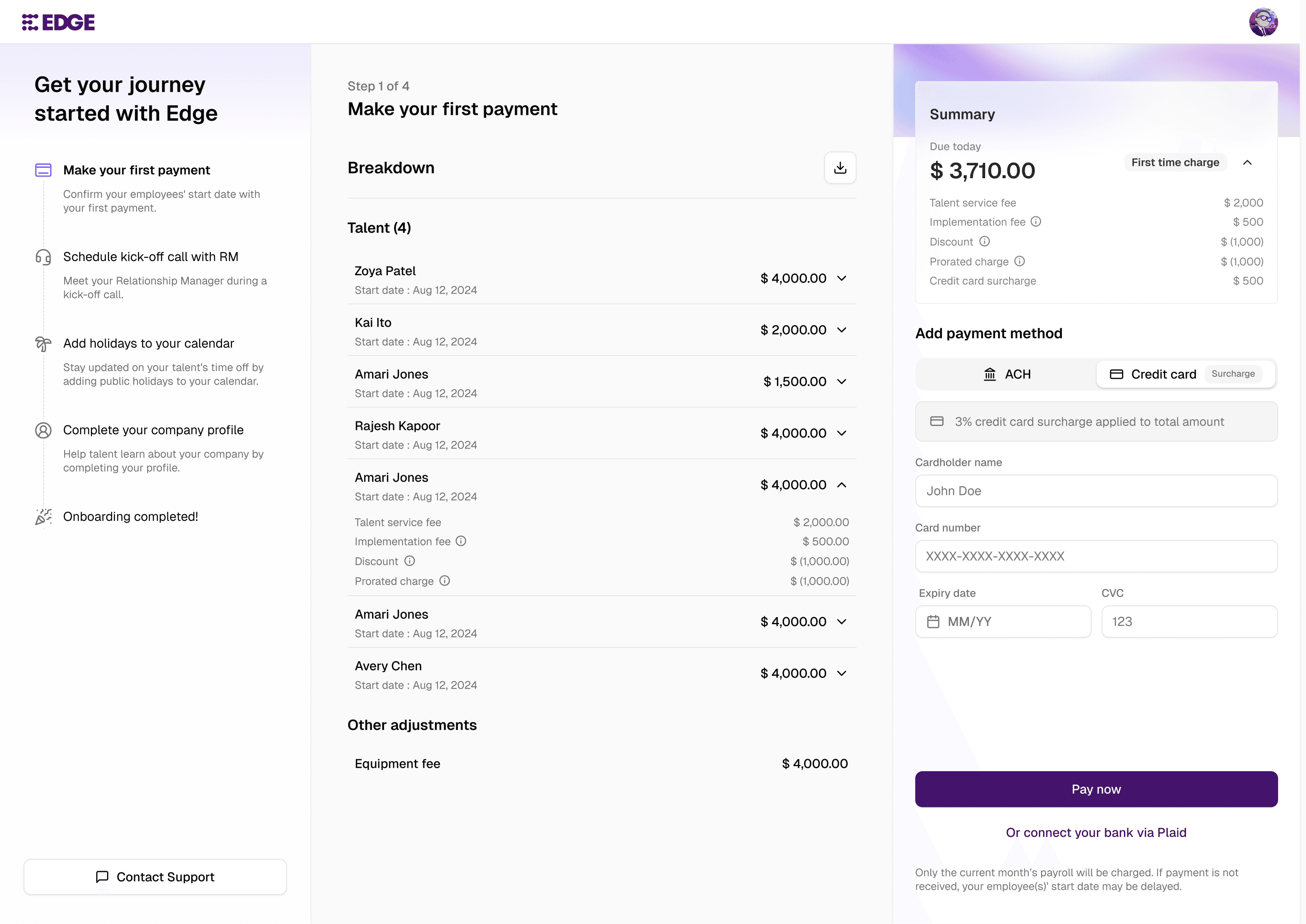
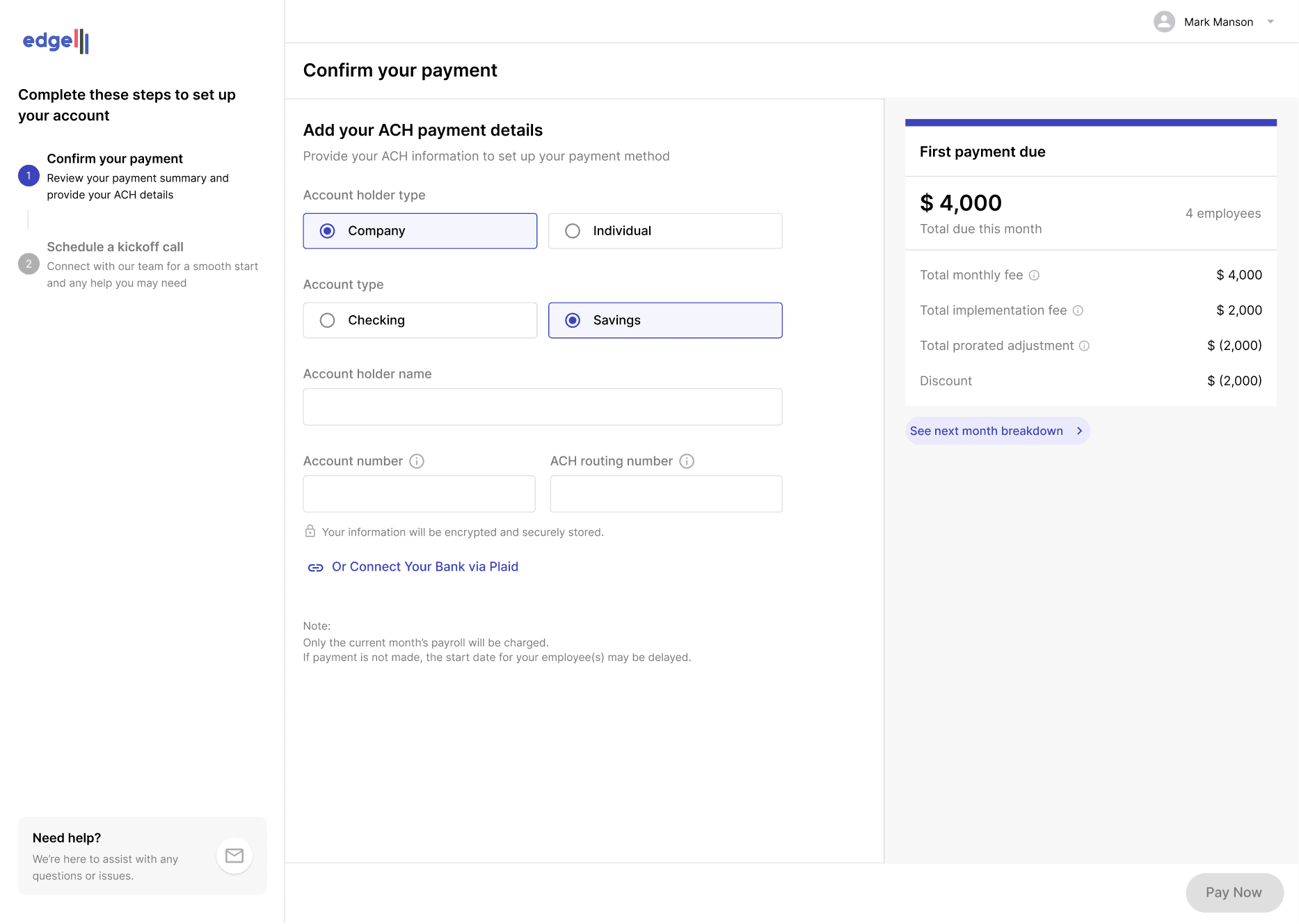
Frictionless First Steps for Low-Attention, Low-Tech Users
Low attention and tech confidence demand simple, intuitive onboarding with no unnecessary steps. Customers arrive via a welcome email with all essential information.
Smarter Surcharge Strategy: Transparency That Reduces Drop-Offs
We identified willingness to pay surcharges and moved to a clear disclaimer approach. State restrictions made flexibility essential, helping reduce drop-offs.
Clarity Drives Conversion: Transparent Talent-Level Pricing
Clear talent-level cost breakdowns reduced onboarding drop-offs. Salesforce integration enabled accurate discount data and start dates, making prorated charges easier to understand.
Claude Generated Prototype (90% accuracy)
Customer Queries
Why is my talent receiving different salary to whats mentioned on the platform?
Distrust in Edge Invoicing
Poor breakdowns
Business assumptions that turned out to be wrong
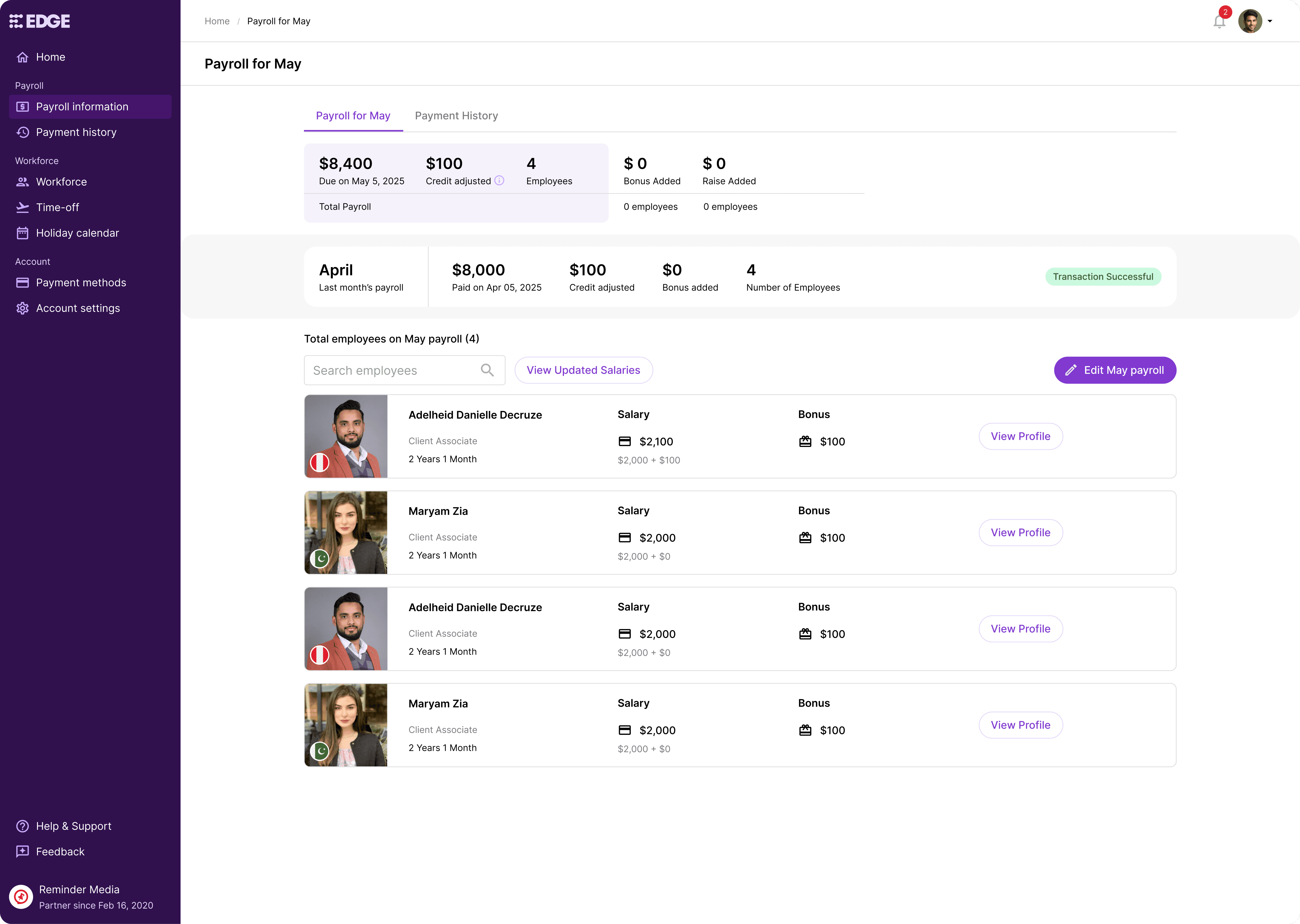
Positioning charges as a single, payroll-style fee encourages customers to take greater ownership of their talent and salaries, while enabling Edge to gradually step back from the middleman role.
Customer will be frequently giving raises to their talent and will have more engagement with the payroll feature
In reality, confusing customers with these additional add-ons and payroll related terms was only leading to more queries and distrust in Edge service.
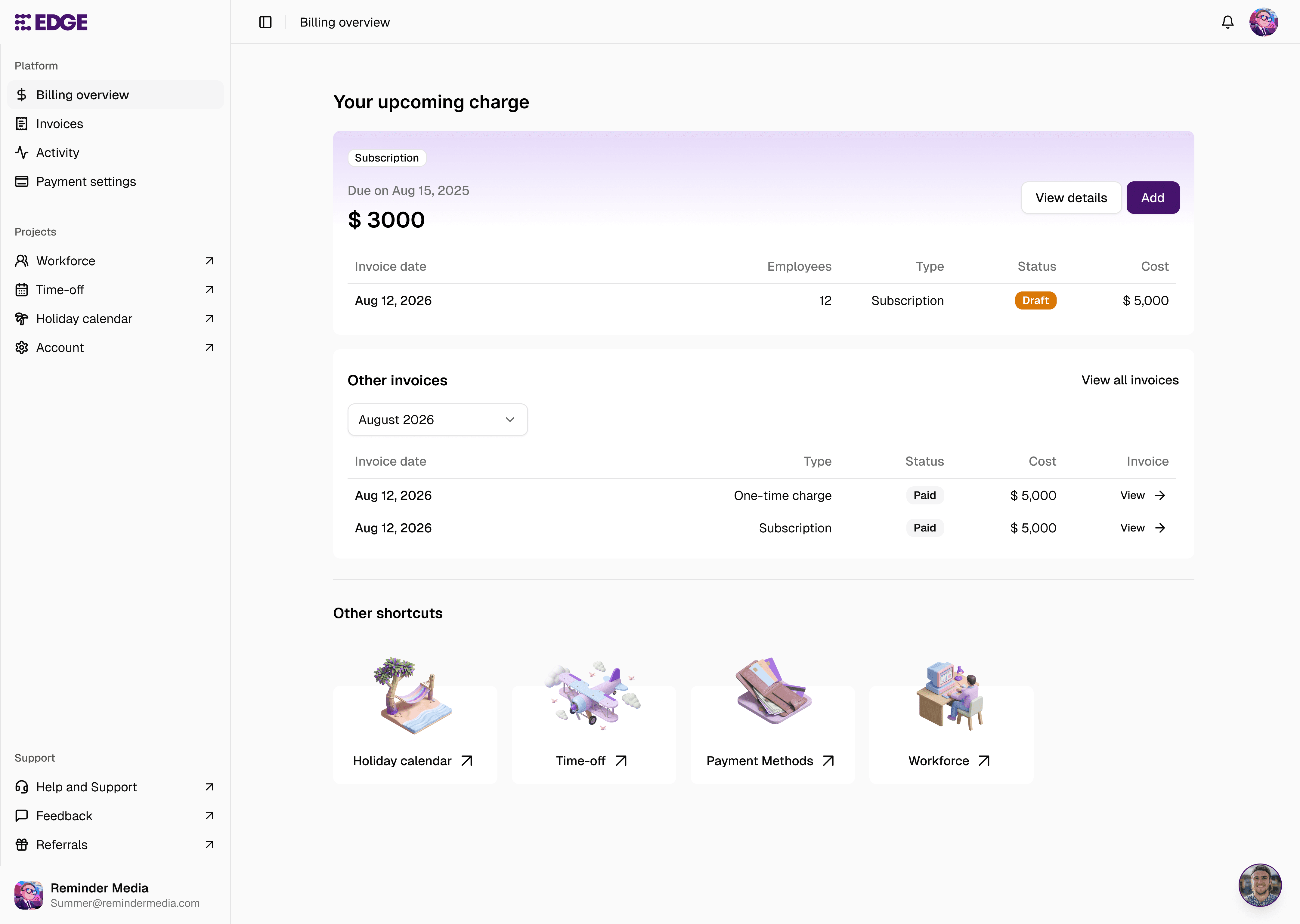
A subscription model unifies Edge fees and talent costs into a simple, clear view.
We found up to 13 line items per talent, with 5 affecting only the customer (e.g., equipment, platform, and implementation fees).
Shifting to a subscription model consolidates these into a single, cohesive view—removing payroll terminology like “salaries.”
Finance platform integration enables precise, talent-level breakdowns with continuous improvements.
Edge relies on multiple third-party software platforms, with use cases spread across systems, making breakdown extraction challenging.
To address this, we began consolidating payments and added items like time-off adjustments to the roadmap, ensuring ongoing improvement in transparency and accuracy.
Transparent Billing: Tracking Payments & Changes Across Edge and Talent
Payment tracking kept customers informed about upcoming charges and reflected the latest updates in real time.
Change tracking ensured transparency whenever Edge Accounts or internal teams adjusted a talent’s total fee.
Exploring AI
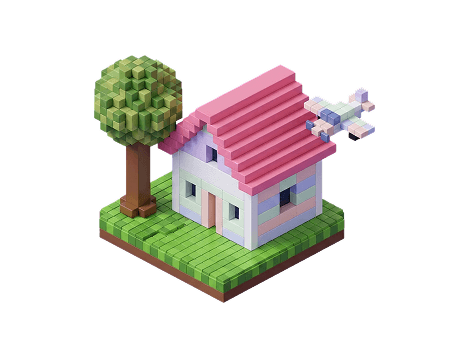
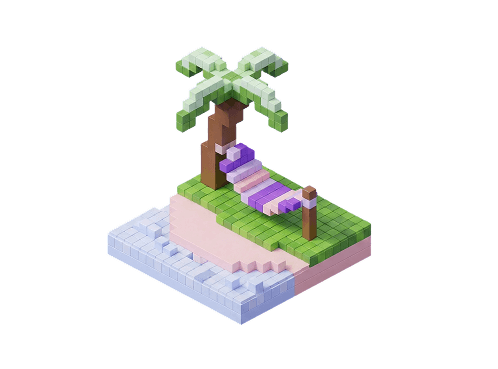
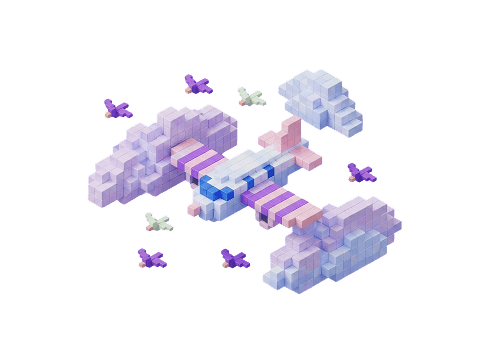
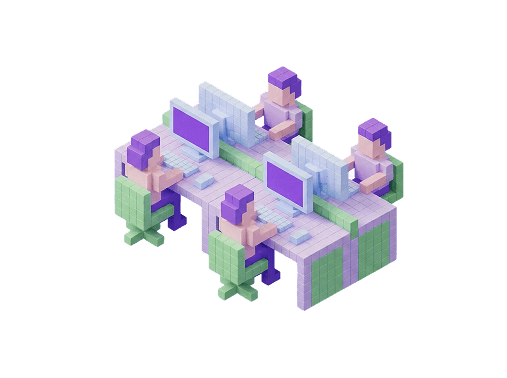
Nanobanana to generate 3D illustrations we can use on our platform
Challenge
Nanobanana to generate 3D illustrations we can use on our platform consistently as illustration need increase with time.
How might we make the results repeatable.
Generate a sketch pencil in a purple shade
{
"icon\_style": {
"perspective": "isometric",
"geometry": {
"proportions": "1:1 ratio canvas, with objects fitting comfortably within margins",
"element\_arrangement": "central dominant object, with supporting elements symmetrically or diagonally placed"
},
"composition": {
"element\_count": "2–4 main objects",
"spatial\_depth": "layered to create sense of dimension and slight elevation",
"scale\_consistency": "uniform object scale across icon set",
"scene\_density": "minimal to moderate, maintaining clarity and visual focus"
},
"lighting": {
"type": "soft ambient light",
"light\_source": "subtle top-right or front-top direction",
"shadow": "gentle drop shadows below and behind objects",
"highlighting": "mild edge illumination to define forms"
},
"textures": {
"material\_finish": "semi-matte to satin surfaces",
"surface\_treatment": "smooth with light tactile variation (e.g., wood grain, soft textures)",
"texture\_realism": "stylized naturalism without hyper-realistic noise"
},
"render\_quality": {
"resolution": "high-resolution octane 3D rendering",
"edge\_definition": "crisp, no outlines; separation achieved via lighting and depth",
"visual\_clarity": "clean, readable shapes with minimal clutter"
},
"color\_palette": {
"tone": "naturalistic with slight saturation boost",
"range": "harmonious muted tones with gentle contrast",
"usage": "distinct colors per object to improve identification and readability"
},
"background": {
"color": "#FFFFFF",
"style": "pure white, flat",
"texture": "none"
},
"stylistic\_tone": "premium, friendly, clean with lifestyle or service-oriented appeal",
"icon\_behavior": {
"branding\_alignment": "neutral enough for broad applications",
"scalability": "legible at small and medium sizes",
"interchangeability": "part of a cohesive icon system with interchangeable subject matter"
}
}
}
3d illustration in a consistent brand style:
- single object
- No shadows on the background and clear background
- area light
- Clear background
- Colors = E5D9F9, DFEFE0,DAE2FF,FAD8DE, 914DE8
- Isometric, retro, skeumorphic and realistic
- Material = actual object materials and textures
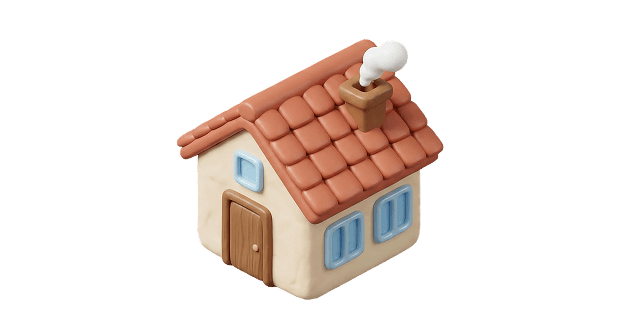
Create a illustration representing 'home'
Create a house with garden and a tree with a car parked
Reference image attached above






Explorations













Future considerations
Build automations to make sure customers are getting a complete breakdown. Items like upsells and down sells, overtime additions were still not factored in due to lack of infrastructure built around it.
Adding the bonus guidelines as part of the bonus adding interface for customer to understand what is a good amount to give someone in a different country
Add contract signing as part of the onboarding which currently happens outside of the platform.